News
- Network News
- Staff Engagement
- Grants & Funding
- Energy Efficiency
- Waste Minimisation
- Water Efficiency
- Local Business
- Sustainable Travel
- Procurement
- Blogs
- Event Reports
- Contact
“The course was great and very well put together.”
Graham Hillier, Cash Bases, Newhaven
Network Update – November 2014
Welcome to November’s Network Update. This month: Sustainable buildings breakfast; Optimum start controls; Solar PV presentations; ESOS; Timba Tree!
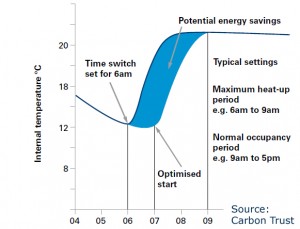 Technology Intro: Optimum Start (and Stop) Controls
Optimum start controls use sensors to measure internal and external temperatures to automatically judge when to switch on the heating system so that the desired temperature is reached at the time set, with no wasted heat beforehand. The Carbon Trust says that 10% savings on heating costs are not uncommon and that the control installation usually pays for itself in less than 5 years.
Optimum stop controls can also be incorporated, to automatically switch off the heating early if the room temperature will remain at a comfortable level until building users vacate.
 Commercial Solar PV: Presentations Now Available
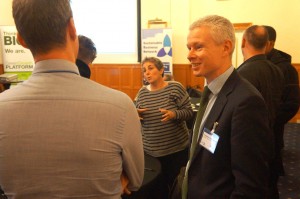
As if planned, the rain cleared and the sun came out as local businesses met for a solar PV breakfast in St. Leonards-on-Sea. Topic experts Ecolution Renewables discussed panel types and efficiencies, the Feed-in-Tariff and typical payback periods. Hastings Borough Council Planning Team explained how Permitted Development Regulations mean that planning permission isn’t always required to install a PV array, and case study Raystede Animal Welfare Centre shared their reasons for installing a 50 kWp system. Presentations.
Regulation: ESOS – Who Needs to Comply?
The Energy Saving Opportunity Scheme (ESOS) has been introduced by government and dictates that organisations that employ over 250 people or have a turnover in excess of €50 million must carry out an assessment of the energy used by their buildings, industrial processes and transport to identify cost-effective energy savings measures. Compliance deadline 5th December 2015. Full details.
 Timba Tree! An Xmas Alternative?
Sussex based Timba Tree have provided a twist on the traditional Christmas Tree or its plastic alternative. Their wooden trees are handmade from FSC certified redwood, sourced from Sweden and Finland, and designed to last a lifetime. In comparison real Christmas trees tend to last just one season and plastic trees on average 5 or 6 years.
Real trees absorb carbon dioxide during growth (typically 5 to 10 years), although this benefit can be undone if the tree ends up in landfill, degrading anaerobically (recycling rates are rising however). Artificial trees are made from oil, a finite resource, and will sit in landfill for over 100 years.
To Sussex and beyond!
Masters placements, businesses sought – Details
University of Brighton Environmental Management, GIS and Town Planning Masters students are available for 6 week placements to work on a project for your business.
European Environmental Indicator Report – Download
What are the global impacts of the EU’s production-consumption systems?
Human Dynamics of Climate Change – View
Met Office graphic showing how climate change will affect human populations across the globe.
Super solar – Space facts
Solar panels power Rosetta space craft through asteroid belt and 800 million miles from sun!